*The following questions and answers are in response to Equality NC’s survey to candidates and elected officials.
If elected, what role will you play in passing nondiscrimination ordinances in your area? If an NDO has already passed in your area, how will you work to bring ordinances forwarded across the state?
I proudly advocated for and helped Asheville pass a comprehensive nondiscrimination ordinance. As a member of the North Carolina Metro Mayors Coalition, I advocate for other municipalities and state legislators to ensure nondiscrimination protections statewide. I testified before the legislature this year defending local governments’ right and responsibility to protect all residents from discrimination.
How will you work to establish community safety? What are your plans to reimagine community safety?
Community safety requires addressing root causes including affordable housing, mental health services, economic opportunity, as well as providing emergency services. I support our REST team that pairs mental health professionals with officers, I oppose criminalizing poverty and homelessness, and I believe safety comes from ensuring everyone has what they need to thrive. I serve on the Asheville-Buncombe Continuum of Care where I work collaboratively with providers in our community to focus our resources on these efforts. I’ll continue investing in crisis intervention, violence prevention programs, and services that keep people housed and healthy.
Do you support allowing local sheriffs to determine their departments’ cooperation with ICE and other immigration enforcement?
Yes; this is and has been my consistent stance on this issue. And I have communicated with Buncombe County’s Sheriff Quentin Miller regarding his position opposing active participation with ICE. I have also issued a joint statement with our County Commission Chair opposing ICE enforcement actions that harm immigrant communities and undermine public safety by making people afraid to report crimes or seek help. At the city level, we have implemented Fourth Amendment workplace training and education.
What measures would you take to support your immigrant communities in your municipality?
I’ll continue being responsive to how our immigrant communities want local government to provide support without making them a target for the federal government. I have taken public positions against ICE invasions in partnership with the Governor. Asheville’s police Chief has publicly reassured the community that APD does not participate in federal immigration enforcement. I continue to support language access in city communications and to oppose policies that force local law enforcement to act as immigration agents.
Would you support housing incarcerated transgender individuals with the population they deem to be the safest option?
Yes. Jails and prisons are recognized as being unsafe, high-risk, traumatic environments for everyone who enters them. I support sweeping reforms to our public safety and criminal justice systems to ensure that deaths, violence and negligence are prevented in our communities and to ensure that incarceration focuses on violence prevention, rehabilitation, and re-entry to prevent collateral consequences.
How would you support banning discrimination in public accommodations (restaurants, hotels, retail businesses, and more) including bathrooms, changing rooms, and locker rooms?
I strongly supported Asheville’s nondiscrimination ordinance. I strongly opposed HB2, North Carolina’s discriminatory “bathroom bill,” – issuing a statement opposing it and reiterating our community’s values. I celebrated when it was repealed. I’ll continue defending local protections against state interference and advocating for statewide laws that protect all North Carolinians from discrimination in public spaces.
What does racial equity mean to you?
Racial equity means acknowledging historical harms and taking concrete action to address ongoing disparities. It means adopting equitable city budgets, providing equitable city services, investing in historically under served neighborhoods, and ensuring equitable power in decision-making. I supported Asheville’s reparations resolution, I defended Asheville before the state legislature with regard to Asheville’s reparations efforts, and I continue working to ensure our policies advance equity.
If elected, how will you support LGBTQ+ folks in your jurisdiction? (i.e. what legislation would you support, what policies would you pursue, what issues would you to try to address)
I’ll continue defending nondiscrimination policies. I’ll oppose legislation targeting LGBTQ+ people. I’ll continue advocating for healthcare access, safety, and full participation in community life.
What specific strategies do you propose or support to ensure the availability of affordable housing for low and moderate-income residents, especially queer and trans folks?
The city of Asheville is a leader in adopting and implementing effective affordable housing tools and policies. These are changes that have taken time to implement and, more importantly, fund. For example, I have successfully helped usher in the city’s first recurring bond program that, in part, funds affordable housing. I’m an effective advocate for deeply affordable housing at 30-60% AMI. LGBTQ+ people experience homelessness at much higher rates than the general population. I’ll continue my advocacy and ensure we create more deeply affordable housing in Asheville.
Given the intense anti-trans rhetoric we have seen over the last few years, how will you be a voice in combating those attacks? In your view, how can your office play a role in this work?
I will continue to use my platform as mayor to speak out clearly for trans rights as human rights and to speak against attacks on trans people. I model inclusiveness and will continue to do so.
LGBTQ+ Healthcare is being limited and cut back through legislation and policy, what is your approach to ensuring healthcare for all North Carolinians? How could you use your office to reach that goal?
Cuts to healthcare and healthcare access in North Carolina are immoral and I believe healthcare is a human right and I will continue to work in support of policies that expand healthcare access for all North Carolinians. In Asheville, I have worked with other elected officials and leaders to try to ensure that our residents receive the best hospital care possible while doing battle with a major local provider. While North Carolina mayors do not directly set healthcare policy or provide funding, we do have the vantage of the bully pulpit and can leverage it to speak out for those being underserved in our communities.
Please share what recent LGBTQ+ focused events that you have attended and the LGBTQ+ organizations that you have supported, including ENC.
I regularly attend a variety of local events when I’m not advocating for Asheville in Raleigh and in Washington D.C.
How will you encourage LGBTQ+ focused events in your role?
I’ll continue supporting Pride events, ensuring city facilities are equally available for LGBTQ+ gatherings, and using my platform to promote LGBTQ+ community events.
How will you partner with ENC to support events centering the LGBTQ+ community?
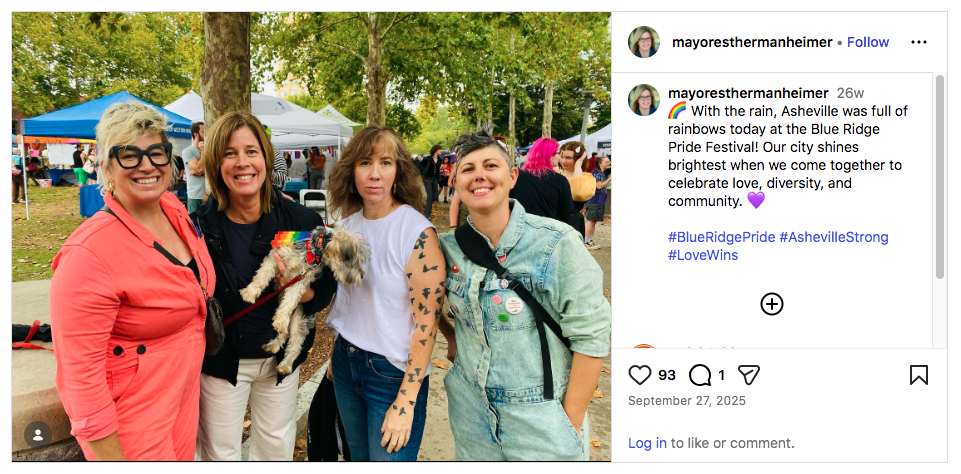
The city works with community groups to host events on city property including the LGBTQ+ community such as the Blue Ridge Pride festival pictured below.