By Sarah Honosky
ASHEVILLE – The wind whipped through the tent as Emily Witherspoon danced under the white awning outside the nearly completed apartment building, dubbed Lady Gloria Ridge Community.
She and dozens of others gathered Oct. 21 for the building’s consecration, celebrating the 41 permanently affordable apartments, the culmination of years of work by Haywood Street Congregation.
The building is expected to be ready for move-in by the end of the year.
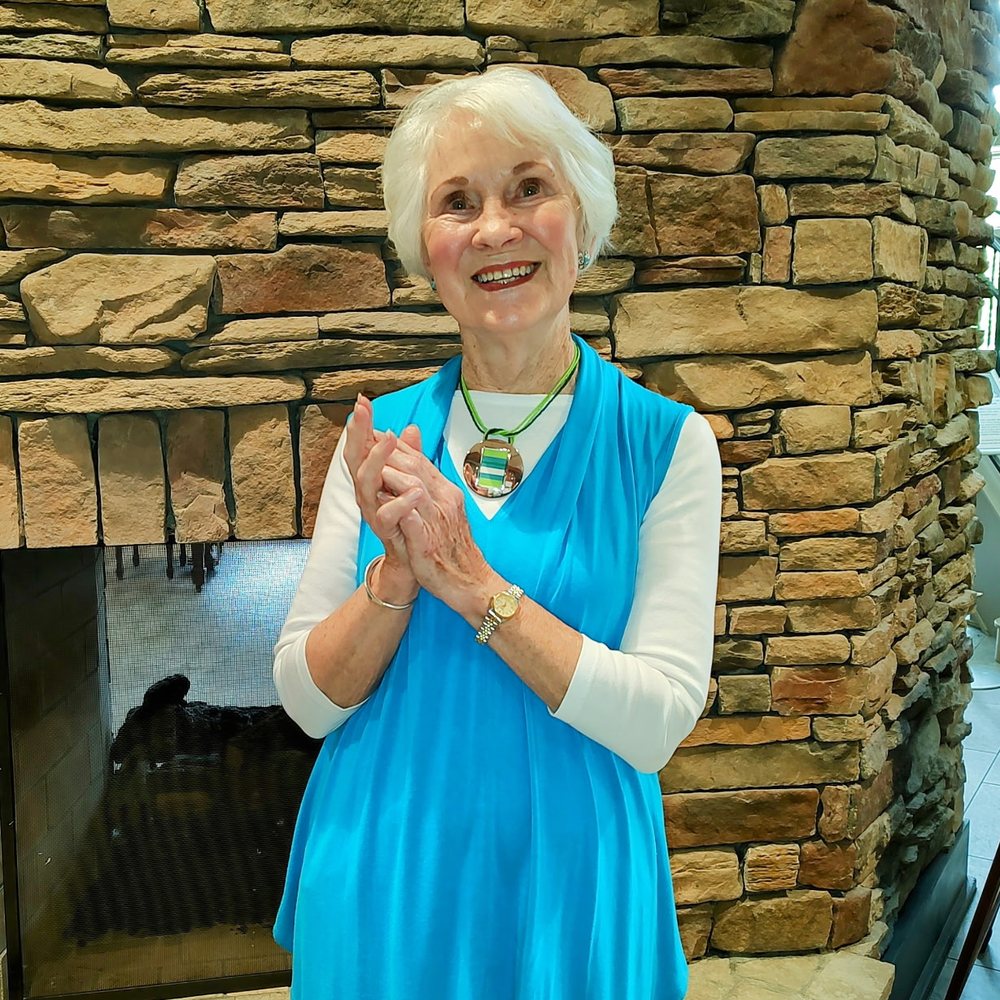
Witherspoon, 47, said she is slated to be among its first residents. Her liturgical dance was one of several event performances, along with remarks from those involved.

She has spent time living Asheville streets and in public housing. She is a breast cancer survivor, and now lives in a house where she pays “a lot of money for a little room.”
To live at Lady Gloria Ridge would be “like heaven on earth,” Witherspoon said she told a pastor at Haywood Street.
“They saved my life, over and over,” she said of Haywood Street.
“I’ve been praying for a safe place where people want us to grow, not to just survive, where I’m not going to be scared.”
The apartments sit on West Haywood Street, with a view of the mountains beyond, on the north end of the West End Clingman Avenue neighborhood. The 1.2 acres are on the edge of downtown, overlooking the confluence of Interstate-26, I-240 and Patton Avenue.

It’s the first project of the Haywood Street Community Development, an affordable housing nonprofit created by nearby Haywood Street Congregation.
The congregation began in 2009 as a “ministry of radical inclusion,” often a sanctuary for people experiencing homelessness, with the mission of “relationship, above all else.” It hosts a midweek Downtown Welcome Table and is home to a 12-bed respite, slated to more than double its capacity in an ongoing expansion.
Lisa Powell, 57, another future resident, said she was homeless when she first came to Asheville from Hickory. She stayed at Western North Carolina Rescue Ministries’ shelter, and later ABCCM’s Transformation Village, which provides transitional housing for women and children. She spent time moving from place to place, staying at other people’s homes, or in hotels.
She has her own place in Asheville now, but said Lady Gloria Ridge will offer a supportive setting that will be better for her health.
“I can’t wait,” she said.

Not just housing, ‘but a home’
The apartments broke ground in February 2024. They are a mix of one-, two- and three-bedroom units, all affordable — with 35 reserved for housing voucher holders whose income is between 30%-50% of the area median income, and the six other units targeting workforce housing at 60% and 80% AMI or below.
Asheville’s median income is $65,188. For a one-person household, 50% AMI is $32,600 and $37,250 for two people.
Teresa Stephens, affordable housing director with Givens Estates, which will manage the property, said the community stands as a testament to what can be accomplished when people “exhaustively and creatively” explore new ways to fund and develop “deeply affordable housing.”
“We live daily with a housing crisis that was made even worse by the hurricane we experienced a year ago,” Stephens said.

Long wait lists for multifamily rentals demonstrate a “notable pent-up demand,” according to the 2025 Asheville region Housing Needs Assessment, released by Bowen National Research.
The report noted that Asheville continues to experience affordability pressures, especially for renters. The city has a five-year housing gap of 11,658 units, with a majority for rental housing.
There were 328 people in Asheville and Buncombe County experiencing unsheltered homelessness in January, according to an annual census. Of those, more than a third said it was due to Tropical Storm Helene.
“Each one of these apartments has the potential to become a home. Not just housing, not just shelter, but a home,” Stephens said.
Honoring ‘Lady Gloria’
The apartments were named for Gloria Howard Free, an Asheville educator and activist born and raised on Clingman Avenue in WECAN.
Free died at 91 in February. She was known affectionately as “Lady Gloria,” and was a founding originator of the Asheville Goombay Festival, created in 1982 to celebrate the richness and diversity of the African diaspora, a showcase of Black culture, art, food and entertainment.
Her daughter, Sherri Free, spoke at the consecration, unveiling a collage of portraits of Gloria to be displayed in the building.
“She had a spirit big as life,” Sherri said. “If you met her, it’s more like you could feel her essence, who she was.”

Housing people with dignity
The $12.45 million project clinched Asheville City Council approval in February 2022, but has been a dream of the congregation for a decade.
“The poorer the people you try to get inside, the harder it is,” said founding Pastor Brian Combs. There are many complicating factors: the capital stack, the price of land, some people’s unwillingness to have developments built near them. The congregation faced the challenges of the pandemic, and then Helene.
“The primary critique is that it’s too nice,” Combs said of the building. “That folks in poverty are only deserving of materials and things that the rest of us throw away. We refuse to believe that.”
With its balconies, granite countertops, high ceilings and a washer and dryer in every unit, Combs said he’s heard developers say it’s nicer than market rate. To that, he says: “that’s exactly the point.”

The website said potential tenants include service industry workers, third-shift laborers, formerly unhoused residents and families struggling to make ends meet. The development is deed restricted to remain affordable in perpetuity.
Of the moment that started the congregation on this journey, Combs said it happens every Wednesday during the church’s Welcome Table, when people come together to share food and stories. If you spend just a few minutes with someone in poverty, inevitably the topic of housing comes up.
“You spend a few moments with a teacher, or a bus driver or a line cook at Waffle House, and housing comes up for them, too. It’s interesting that every year we do these surveys when we poll citizens here in town, and housing is always the No. 1 issue,” he said.
“And for folks that are right on the precarious line between housing insecurity or homelessness, it’s been the biggest issue for an entire lifetime.”
How to apply
Lady Gloria Ridge Community’s income-based units have been filled, but it is still accepting applications for voucher units, which can be found online at haywoodstreethousing.org/communities/current-project/ or by calling 828-570-5708.
Sarah Honosky is the city government reporter for the Asheville Citizen Times, part of the USA TODAY Network. News Tips? Email shonosky@citizentimes.com or message on Twitter at @slhonosky.