
ISSUES
Home »

leadership, vision & city goals
What is your overall vision for Asheville over the next four years, and what are the top three goals you want to accomplish as mayor?
My vision for Asheville is a city where working families can afford to live, neighborhoods are protected from climate risks, and opportunity is within reach for everyone. By responsibly investing the nearly $1 billion in federal and state recovery funds I fought to secure for our community, paid out over the next six years, we can preserve and create deeply affordable housing, build climate-resilient infrastructure, and grow an economy that works for all residents - ensuring Asheville remains a place people can build their lives, not just visit.
How do you define the role of the mayor in shaping city policy, especially in collaboration with the city council?
The mayor's role is to build consensus, advocate for our community at local, state, and federal levels, and be a steward of decision-making that benefits Asheville residents, particularly residents with the greatest reliance on city services. I work collaboratively with council members to set priorities, but I also leverage relationships I've built with governors, congressional leaders, and federal agencies to secure resources and support that council alone cannot access.
What distinguishes your leadership style from the other candidates?
My experience building bipartisan relationships at every level of government and my track record of follow-through on commitments distinguish me from others who haven't been tested in this way. I've proven I can deliver results during our community's greatest crisis, from securing millions in federal recovery funding to maintaining calm, effective leadership when residents needed it most.
housing & affordability Issues
Housing costs continue to rise. What specific policies would you pursue to increase affordable housing and support residents at risk of displacement?
We must expand housing options in Asheville by encouraging well-planned, dense infill development in appropriate areas while protecting the character and stability of our legacy neighborhoods. Growth should strengthen our community, not displace the people who built it. That means pairing new housing with strong anti-displacement strategies, preserving naturally occurring affordable homes, supporting longtime residents, and ensuring that as Asheville grows, the families and neighbors who give our city its history and identity can continue to call it home.
I have brought together community members, council colleagues, and city staff to chart a collaborative path forward to protect our legacy neighborhoods, particularly through the development and implementation of meaningful anti-displacement policies. I will continue serving as a consensus builder on Council, guiding affordable housing projects from conception through construction.
We can adopt all the policy in the world, but without collaboration and the votes needed to move projects forward, we will still fail to create the housing our community needs. My approach is to bring people together, build trust, and turn shared goals into real homes for Asheville residents.
Do you support zoning changes to allow more multifamily and affordable housing development? Why or why not?
Yes, I support thoughtful zoning changes that increase housing options, and I have a track record of supporting these changes already. We can preserve neighborhood character and ensure adequate infrastructure issues while creating new housing. We especially need more "missing middle" housing - duplexes, triplexes, and small multifamily buildings - and we must stop the city’s delays (whether political or regulatory) and reduce barriers that make it difficult to build affordable units quickly.
What would you do to preserve existing affordable housing stock and protect long-term residents?
Preserving existing affordable housing and protecting long-term residents is one of the most urgent challenges facing Asheville, and there is no single silver bullet. The City’s Missing Middle Housing Study makes clear that we must pursue both preservation and thoughtful growth at the same time.
First, we must help longtime homeowners remain in their homes through property tax relief, home repair assistance, and aging-in-place programs. Rising property values should not force out the residents who built Asheville’s legacy neighborhoods.
Second, we should strengthen code enforcement efforts focused on abandoned and derelict properties that destabilize neighborhoods and remove usable housing from our inventory. Bringing neglected homes back into safe, productive use helps preserve neighborhood stability, improves safety, and expands our existing housing supply without changing community character.
Third, we must continue supporting and expanding rent assistance and eviction-prevention programs that help renters weather temporary financial hardships. Strategic rental assistance keeps families housed, prevents displacement, and is often far less costly than addressing homelessness after a crisis occurs.
Fourth, I strongly support adopting and implementing a comprehensive anti-displacement policy currently being developed by staff, including tools such as displacement risk monitoring and targeted investments in vulnerable neighborhoods before market pressures accelerate.
Finally, the Missing Middle Housing Study shows that protecting residents also requires expanding housing choices. By allowing context-sensitive infill housing, such as duplexes, accessory dwelling units, and small multiplexes, in appropriate areas, we can add attainable homes while respecting neighborhood scale. Increasing supply in a thoughtful way reduces price pressure citywide and helps prevent displacement rather than accelerate it.
Our goal should be clear: preserve existing affordable homes, protect longtime residents, and guide growth so Asheville remains a city where people can build a life, not a place where only newcomers can afford to live.
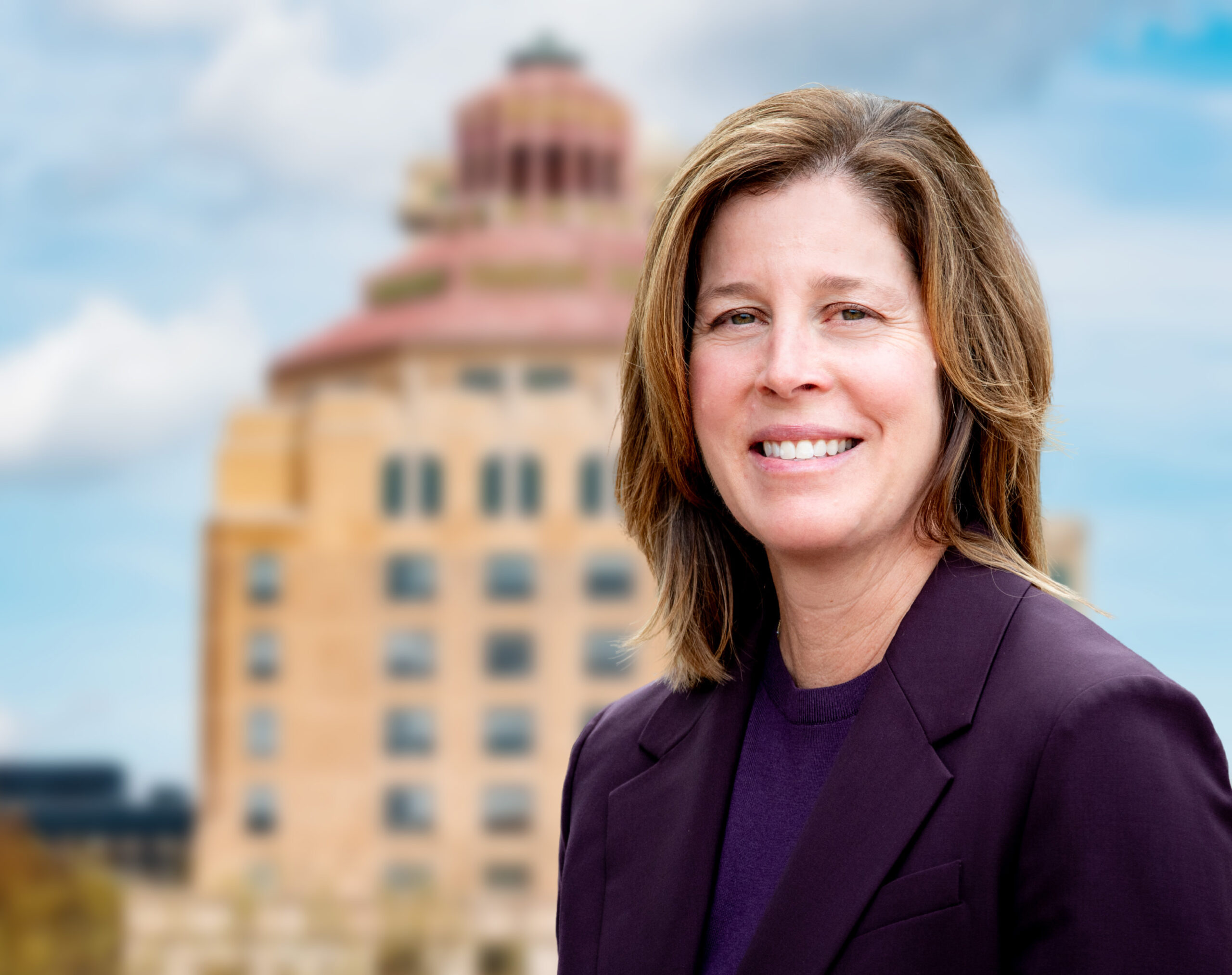
"Preserving existing affordable housing and protecting long-term residents is one of the most urgent challenges facing Asheville."
Homelessness & Social Services
What strategies would you implement to address homelessness comprehensively and compassionately?
Through my service on the Asheville-Buncombe Continuum of Care, I will continue expanding shelter capacity, supporting proven programs like our Resource and Engagement Support Team (REST) team that connects people to services rather than criminalizing homelessness, and advocating for the state and federal resources required to address root causes. I strongly support a housing-first approach that provides immediate shelter and connects people to mental health services, substance use treatment, and job support that leads to permanent housing.
How should the city balance enforcement, shelter services, mental health support and affordable housing in its homelessness response?
I oppose criminalizing poverty. Over the last several years, the city has intentionally moved away from a law enforcement response to one where we lead with services: adding shelter beds, connecting people to mental health and addiction treatment (which requires collaboration and many streams of funding), and building pathways to permanent affordable housing. If and when enforcement is required due to public health and safety concerns, that enforcement is coupled with alternatives such as immediate shelter and support.
Are you supportive of expanding safe rest areas or sanctioned encampments? Why or why not?
Safe rest areas help as a harm-reduction strategy when they include wraparound services, case management, and clear pathways to permanent housing, but they are not permanent or preventative solutions. Sanctioned encampments without services concentrate suffering and create risks for encampment residents (especially women and children) as well as neighbors. We must do better for our unhoused population than sanctioned encampments.
Economic Development & Jobs
How will you support small businesses and entrepreneurs in Asheville?
We must also address the fundamentals: affordable commercial space, reliable infrastructure, and a workforce that can afford to live here, which means investing in our water system, affordable housing, and transportation. I advocate for streamlining permitting processes, supporting small business technical assistance programs, and ensuring recovery funding creates opportunities for local entrepreneurs.
Specifically addressing small business recovery after Helebe, the city launched a major recovery effort focused on stabilizing small businesses damaged by flooding and economic disruption. For example, in January 2026, the council approved $15.5 million in direct small-business support, funded through federal disaster-recovery dollars that I worked hard to secure, with grants administered by local partners including Mountain BizWorks, ArtsAVL, Eagle Market Streets Development Corporation, and Venture Asheville. These funds help businesses replace equipment, cover operating costs, retain employees, and reopen locations. Earlier recovery programs also provided emergency grants through the Mountain Strong Fund for Business Recovery and tourism-focused microgrants from the Always Asheville Fund. Altogether, Asheville is using part of roughly $225 million in federal disaster-recovery funding to support long-term economic revitalization, prioritizing locally owned businesses that form the backbone of the region’s tourism, arts, and neighborhood economies.
What is your approach to attracting jobs, especially those that pay living wages?
I serve on the Asheville Buncombe Economic Development Coalition and there I focus on companies that align with our values, those offering living wages or much higher than living wages, good benefits, and career pathways and that support our community through investments, volunteer service, and contributions beyond taxes. We should leverage our quality of life (our beautiful environment, our arts and crafts, our welcoming city) and educated workforce to attract advanced manufacturing, technology, and clean energy jobs, while also ensuring our existing major employers like Mission Health and hospitality businesses raise wages to meet the true cost of living here.
How should the city balance tourism (a major economic driver) with quality of life for residents?
My priority is clear: ensure Asheville is a great place to live and work for residents. When we do that, it will naturally be a great place to visit. This means investing in infrastructure that serves residents first, managing short-term rentals to preserve long-term housing, and advocating for tourism revenue to pay living wages and better for hospitality workers (many of whom are residents, unless they can’t afford to live in Asheville), and help fund the services our community needs.
"I oppose criminalizing poverty.
Over the last several years, Asheville has intentionally moved away from a law enforcement response to one where we lead with services: adding shelter beds, connecting people to mental health and addiction treatment, and building pathways to permanent affordable housing."
Transportation & Infrastructure
What are your priorities for improving transportation issues, including traffic flow, public transit, bike/ped infrastructure, and parking?
We do not have enough options for all people, particularly people with disabilities, and people who would either like to walk, bike, or ride the bus more or for whom walking, biking or riding the bus are their only affordable options. As mayor I have been working to improve transportation options by expanding multimodal infrastructure. I personally worked hard to promote the 2016 general obligation bond package which is and has allowed the city to leverage millions of dollars for multimodal transportation, specifically in the areas of sidewalk and greenway construction.
I also worked hard to support the 2024, 80 million dollar bond package that will allow us to build upon those infrastructure investments.
Transit is also a transportation mode that I am proud to have expanded during my tenure, but which still falls short of meeting all the needs of people for whom a bus is their only affordable option. Since I have been in office the City Council has worked to improve public transportation by continuing to grow the funding of the Transit Master Plan which includes increasing the number of bus routes, the frequency of those routes, adding Saturday and Sunday service, evening service and enhanced bus stops. I will continue to support the improvement of Asheville's public transportation system toward the ideal of efficient, frequent, reliable service.
How would you ensure infrastructure investments are equitable across all neighborhoods?
I'll continue prioritizing historically underserved neighborhoods that have faced decades of disinvestment, continue using data to identify gaps in sidewalks, stormwater management, street conditions, and green space access. Our bond packages and recovery funding must deliberately address these inequities, not just maintain what wealthier areas already have, and I'll ensure community input drives decisions so residents shape investments and issues in their own neighborhoods rather than having solutions imposed on them.
Do you support expanding public transit options, and if so, how should they be funded?
After decades of implementing various marketing strategies and route changes/improvements, the vast majority of our bus riders continue to be people who rely on it as an essential service (out of need). This indicates that the majority of city residents who are potential riders actively choose other forms of transportation that are available to them, and it is likely that they are choosing transportation that contributes to emissions and/or congestion. That is a choice they are making. I am willing to put it to the voters to ask them if they want to invest in a sales tax for public transit (which North Carolina allows as a county-wide referendum), which could exponentially improve services for our necessity riders, and which could reduce emissions and congestion if more residents would choose to ride the bus.
Public Safety, Police & Community Trust
What is your vision for public safety in Asheville, and how should the city address concerns around policing?
Public safety issues require both professional, accountable policing and investment in addressing root causes, mental health services, affordable housing, economic opportunity, and community programs that help prevent crises. I support our police officers and recognize their intended role in crime prevention, patrolling and enforcement, and investigations. In the last several years, the city has worked to pay officers a better wage and rebuild the ranks in the department. This last month, I had the honor of swearing in 20 new officers, many of whom were men and women born and raised in our community. I also demand transparency, accountability, and community engagement. I believe safety comes from addressing why people struggle, not just responding after harm occurs.
Do you support reallocating funds to community-based programs, and if so, which ones?
I support strategic investment in proven “right response” programs like our REST Program, or Resource and Engagement Support Team, which is a public-safety and outreach initiative operated by the Asheville Fire Department that responds to non-emergency community concerns, particularly those involving homelessness and community well-being. Instead of relying on police enforcement, REST teams engage directly with individuals, connect them to housing, healthcare, food assistance, and social services, and work with residents and business owners to resolve ongoing issues in a supportive, service-focused way. Created to bridge the gap between emergency response and social services, the program aims to reduce repeat emergency calls while improving long-term community stability,I support deploying our police to address serious crime (from prevention through investigations).
How would you strengthen trust between law enforcement and the community?
APD is tasked with strengthening that trust, which is necessary for crime prevention and fruitful investigations of crime, and I support that aim. The department has a team focused on this effort in the Community Engagement Division. Trust is built through transparency, accountability, and genuine community engagement. I support body cameras with clear policies, regular community forums where residents can voice concerns directly to leadership, and recruiting officers who reflect our community's diversity and are committed to procedural justice and de-escalation.

"Be brave and relentless and keep the focus on moving forward."
"Be brave and relentless and keep the focus on moving forward."
Environment & Sustainability Issues
What actions would you take to address climate change and reduce Asheville’s carbon footprint?
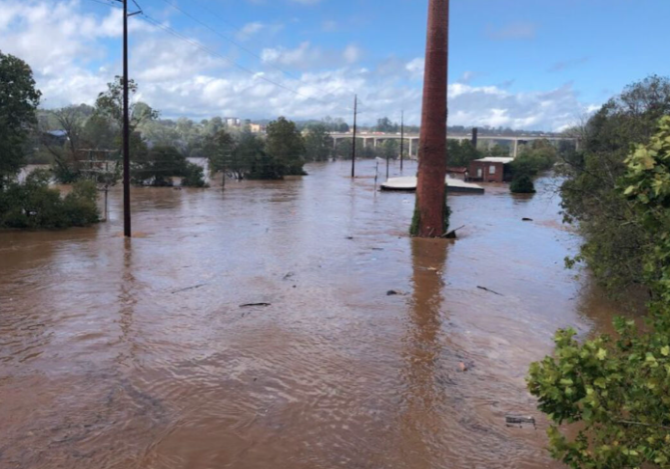
I’ve been advocating for and advancing climate change mitigation throughout my years of service, pre-Helene, and leading on ensuring mitigation is woven into our recovery efforts. It is anticipated that Asheville will receive approximately one billion dollars in federal funding related to Helene recovery and much of this funding is required to be spent on mitigation projects. This includes investment in the City’s water infrastructure, funding a water filtration system for Northfork costing more than 100 million. This includes rebuilding the Swannanoa River parks and the French Broad River parks, utilizing hazard mitigation funds that incorporate mitigation and build resiliency. This means creating resilience centers in partnership with the community to build on the strength of our neighborhood and communities and support and formalize the grassroots response that neighbors provided for one another in a time of crisis, to better prepare us for future climate disasters, which we know will happen. To make all of this a reality will require continuous advocacy in Washington to force the Department of Homeland Security to release the funding that has already been allocated by the Congress specifically for the recovery of WNC. This is an ongoing battle and one that I am laser focused on, working with our Congressional delegation and our Governor to hammer home. My continued work as Co-Chair of the Governor’s WNC Recovery Committee gives me a unique position to advocate for our community’s needs and issues.
How should the city manage growth while protecting green space and Asheville’s natural beauty?
We need to ensure that all future development enhances our environment, protecting watersheds, tree canopy, and the natural beauty that makes Asheville special. We can ensure that in part through thoughtful zoning changes. We must plan strategically for denser, mixed-use development near transit corridors and existing infrastructure rather than sprawling into green space and mountainsides. My personal advocacy for our bond investments in parks and greenways, and housing policies that encourage dense infill on urban corridors, shows my commitment to preserving natural areas.
What’s your plan for waste reduction, sustainable energy, and resilience to extreme weather?
See my first response in this section regarding resilience to extreme weather. Regarding waste reduction, our city has a food waste reduction program and it includes a pilot project we are running to test the public’s interest in composting, which I support. Like most city services, we need to offer what residents need and want and find a balance between what we may wish they would do and what they choose to do. Residents have used this project to divert one million pounds of food waste from landfills, and I support analysis of the data and further public engagement to find out whether municipal composting services are a priority for our residents.
Fiscal Responsibility & Budget
As mayor, how would you ensure balanced budgets while still investing in critical services?
I've demonstrated fiscal responsibility by negotiating what's been called "the most equitable budget in Asheville's history" while maintaining our strong bond rating and financial stability. The city has always maintained a balanced budget, even in the face of challenging financial revenue outlooks. The city maintains a AAA bond rating, another reflection of year over year careful budget planning and management. I prioritize strategic investments that prevent costly problems later, affordable housing prevents homelessness, infrastructure maintenance prevents expensive failures, and climate resilience prevents disaster harms and costs, while seeking every available state and federal dollar to leverage local resources.
What do you see as the city’s biggest budget priorities?
Our biggest priorities must be affordable housing, climate-resilient infrastructure, competitive pay for city employees, including police and firefighters, in order to retain experienced staff, and services that directly improve residents' quality of life. Recovery funding creates a once-in-a-generation opportunity to address infrastructure investment, investment in historically underserved neighborhoods, and building resilience through investments in programs like resilience hubs, but we must also ensure ongoing operations are sustainable and that we're investing in prevention rather than just responding to crises.
How will you engage the community in budget decisions?
I support transparent, accessible budget processes including public forums in different neighborhoods, online engagement tools that reach working families who can't attend evening meetings, and clear communication about tradeoffs and choices. Community input should inform priorities before the budget is drafted, not just react to it afterward, and we must ensure underrepresented voices, including renters, working families, and communities of color, have genuine influence over how public dollars are spent.
Building on this process, the city has created four Helene Recovery Boards to guide long-term rebuilding and ensure community input shaped recovery decisions. The boards focus on four major areas: housing, infrastructure, the economy, and people and environment. Each board is made up of community leaders and representatives from existing city advisory commissions and meets regularly to provide policy recommendations to the council. The Housing Recovery Board works on stabilizing displaced residents and developing both temporary and permanent housing solutions, while the Infrastructure Recovery Board focuses on rebuilding public systems such as transportation, utilities, and resilient infrastructure. The Economy Recovery Board supports small-business recovery, workforce development, and strategies to strengthen long-term economic resilience, and the People and Environment Recovery Board addresses community well-being, neighborhood resilience, and environmental recovery efforts. Together, these four boards function as advisory bodies that increase transparency, gather public input, and help coordinate Asheville’s long-term recovery strategy following Hurricane Helene.
Community Engagement & Equity
How would you ensure transparency and public participation in city government?
I remain committed to accessible, transparent government through multiple engagement channels, public forums, online tools, clear communication about issues before decisions are made, and meeting people where they are rather than expecting everyone to navigate complex government processes. Over the last several years, I have worked hard to support the expansion of the city’s engagement and transparency. In fact, the city created a division solely dedicated to this effort, the Communications and Public Engagement division. Robust public involvement in and knowledge of the city’s decision making is key to making meaningful change in our city.
What steps will you take to make city services more equitable for historically underserved communities?
I support two major initiatives that will build on the city’s multi-year redirection of resources to traditionally underserved communities: One is Reparations. Because I am passionate about this issue, I testified before the legislature in February of 2026, explaining the fairness and value of government providing equitable services and the fairness and value of acknowledging that the government has had policies that historically underserved certain communities. Our city operates within the law to ensure equitable city services. Two is a strategic and community-lead investment of the 225 million in hurricane relief, that I fought for in Washington, 70% of which, per HUD guidelines, must be invested in low to moderate income neighborhoods.This is an unprecedented and transformational amount of funding available to invest in our historically underserved neighborhoods.
How should the city address racial and economic disparities in Asheville?
For the last several years, the City has begun to step up and identify its role in inflicting historical harms and identifying key changes needed in its operations and investments to address those harms. That means, today, investing funding to enhance neighborhoods that were historically neglected, and, in some cases, physically torn apart through takings and redlining. This funding is used to build parks, recreational amenities, infrastructure, home repair repair, and creating opportunities for jobs through small business support. However, these investments must be community led, not a top down approach to deciding how and where investments addressing disparities are made.
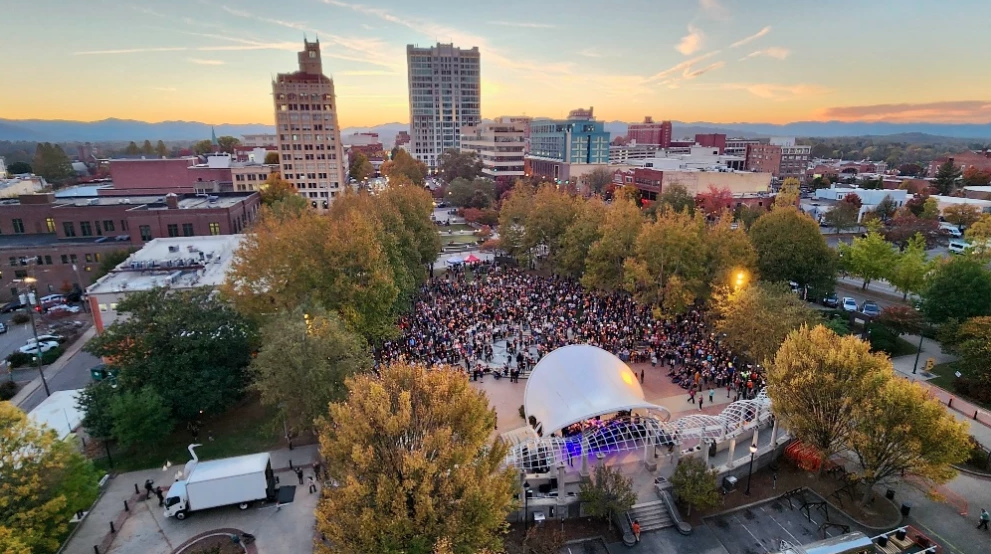
"My vision for Asheville is a city where working families can afford to live, neighborhoods are protected from climate risks, and opportunity is within reach for everyone."
Quality of Life
What are your priorities for parks, arts, culture, and recreation in Asheville?
I believe one of the critical obligations and roles of a city is to provide spaces for people to come together and enjoy one another. That means maintaining and improving the many city parks, and providing programming for children and adults. That means providing and supporting spaces like McCormick Field, the WNC Nature Center, Harrah’s Cherokee Center and Pack Square Park. The City’s job is to create places for people to enjoy, experience and participate in the arts. This is essential to our quality of life,and allows us to create connections between neighbors. Accessibility and affordability is my priority for supporting our parks, arts and culture. I’ll continue to use our bonds to invest in parks and greenways that provide accessible recreation for all residents.
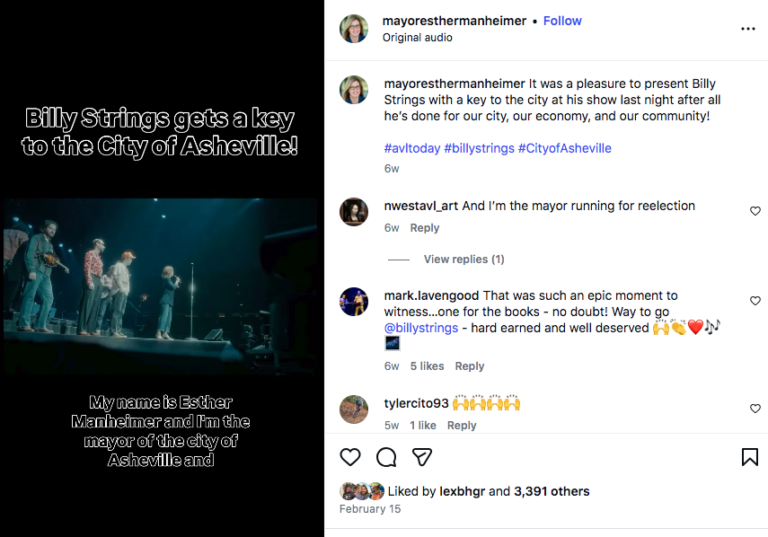
In February 2026, I was happy to present a key to the city to Billy Strings who has supported Asheville in many ways especially after Hurricane Helene.
How would you address issues like noise, nightlife impacts, and livability for residents?
The City undertook a full rewrite of the noise ordinance and hundreds of residents participated in that process. The result is a more balanced approach to ensuring we have peaceful neighborhoods while allowing our creative culture to thrive through music and events appropriately timed and placed. This also means enforcing the noise ordinance fairly. Prior to the rewrite of the noise ordinance, the City was receiving 2000 noise complaints a year, all being enforced through the police department. Noise enforcement is now not a police function and has been moved to code enforcement where the City works proactively with venue owners on sound mitigation to prevent excess noise. Downtown vitality and residential livability (downtown and in adjacent neighborhoods) aren't mutually exclusive, but we must acknowledge when entertainment noise creates genuine conflicts and work collaboratively to find solutions.
What is your approach to supporting youth and families in the community?
I am the mother of three boys, Asheville natives who are now in their late teens and twenties, and I draw on that for insights. Young people in Asheville need stability, opportunity, and connection. Families consistently point to housing affordability, youth mental health supports, affordable childcare, safe transportation, and accessible enrichment opportunities outside the classroom. Afterschool and summer programs are especially important for working families and student success. Programs like the City-supported In Real Life afterschool program at Asheville Middle School, Parks and Recreation programming at recreation centers, youth sports leagues, and summer camps provide safe spaces where kids can learn, build confidence, and stay engaged. Expanding equitable access to these opportunities should remain a City priority.
equality & lgbtq+
*The following questions and answers are in response to Equality NC's survey to candidates and elected officials.
If elected, what role will you play in passing nondiscrimination ordinances in your area? If an NDO has already passed in your area, how will you work to bring ordinances forwarded across the state?
I proudly advocated for and helped Asheville pass a comprehensive nondiscrimination ordinance. As a member of the North Carolina Metro Mayors Coalition, I advocate for other municipalities and state legislators to ensure nondiscrimination protections statewide. I testified before the legislature this year defending local governments' right and responsibility to protect all residents from discrimination.
How will you work to establish community safety? What are your plans to reimagine community safety?
Community safety requires addressing root causes including affordable housing, mental health services, economic opportunity, as well as providing emergency services. I support our REST team that pairs mental health professionals with officers, I oppose criminalizing poverty and homelessness, and I believe safety comes from ensuring everyone has what they need to thrive. I serve on the Asheville-Buncombe Continuum of Care where I work collaboratively with providers in our community to focus our resources on these efforts. I'll continue investing in crisis intervention, violence prevention programs, and services that keep people housed and healthy.
Do you support allowing local sheriffs to determine their departments’ cooperation with ICE and other immigration enforcement?
Yes; this is and has been my consistent stance on this issue. And I have communicated with Buncombe County’s Sheriff Quentin Miller regarding his position opposing active participation with ICE. I have also issued a joint statement with our County Commission Chair opposing ICE enforcement actions that harm immigrant communities and undermine public safety by making people afraid to report crimes or seek help. At the city level, we have implemented Fourth Amendment workplace training and education.
What measures would you take to support your immigrant communities in your municipality?
I'll continue being responsive to how our immigrant communities want local government to provide support without making them a target for the federal government. I have taken public positions against ICE invasions in partnership with the Governor. Asheville’s police Chief has publicly reassured the community that APD does not participate in federal immigration enforcement. I continue to support language access in city communications and to oppose policies that force local law enforcement to act as immigration agents.
Would you support housing incarcerated transgender individuals with the population they deem to be the safest option?
Yes. Jails and prisons are recognized as being unsafe, high-risk, traumatic environments for everyone who enters them. I support sweeping reforms to our public safety and criminal justice systems to ensure that deaths, violence and negligence are prevented in our communities and to ensure that incarceration focuses on violence prevention, rehabilitation, and re-entry to prevent collateral consequences.
How would you support banning discrimination in public accommodations (restaurants, hotels, retail businesses, and more) including bathrooms, changing rooms, and locker rooms?
I strongly supported Asheville's nondiscrimination ordinance. I strongly opposed HB2, North Carolina's discriminatory "bathroom bill," - issuing a statement opposing it and reiterating our community’s values. I celebrated when it was repealed. I'll continue defending local protections against state interference and advocating for statewide laws that protect all North Carolinians from discrimination in public spaces.
What does racial equity mean to you?
Racial equity means acknowledging historical harms and taking concrete action to address ongoing disparities. It means adopting equitable city budgets, providing equitable city services, investing in historically under served neighborhoods, and ensuring equitable power in decision-making. I supported Asheville's reparations resolution, I defended Asheville before the state legislature with regard to Asheville’s reparations efforts, and I continue working to ensure our policies advance equity.
If elected, how will you support LGBTQ+ folks in your jurisdiction? (i.e. what legislation would you support, what policies would you pursue, what issues would you to try to address)
I'll continue defending nondiscrimination policies. I'll oppose legislation targeting LGBTQ+ people. I’ll continue advocating for healthcare access, safety, and full participation in community life.
What specific strategies do you propose or support to ensure the availability of affordable housing for low and moderate-income residents, especially queer and trans folks?
The city of Asheville is a leader in adopting and implementing effective affordable housing tools and policies. These are changes that have taken time to implement and, more importantly, fund. For example, I have successfully helped usher in the city’s first recurring bond program that, in part, funds affordable housing. I'm an effective advocate for deeply affordable housing at 30-60% AMI. LGBTQ+ people experience homelessness at much higher rates than the general population. I’ll continue my advocacy and ensure we create more deeply affordable housing in Asheville.
Given the intense anti-trans rhetoric we have seen over the last few years, how will you be a voice in combating those attacks? In your view, how can your office play a role in this work?
I will continue to use my platform as mayor to speak out clearly for trans rights as human rights and to speak against attacks on trans people. I model inclusiveness and will continue to do so.
LGBTQ+ Healthcare is being limited and cut back through legislation and policy, what is your approach to ensuring healthcare for all North Carolinians? How could you use your office to reach that goal?
Cuts to healthcare and healthcare access in North Carolina are immoral and I believe healthcare is a human right and I will continue to work in support of policies that expand healthcare access for all North Carolinians. In Asheville, I have worked with other elected officials and leaders to try to ensure that our residents receive the best hospital care possible while doing battle with a major local provider. While North Carolina mayors do not directly set healthcare policy or provide funding, we do have the vantage of the bully pulpit and can leverage it to speak out for those being underserved in our communities.
Please share what recent LGBTQ+ focused events that you have attended and the LGBTQ+ organizations that you have supported, including ENC.
I regularly attend a variety of local events when I’m not advocating for Asheville in Raleigh and in Washington D.C.
How will you encourage LGBTQ+ focused events in your role?
I'll continue supporting Pride events, ensuring city facilities are equally available for LGBTQ+ gatherings, and using my platform to promote LGBTQ+ community events.
How will you partner with ENC to support events centering the LGBTQ+ community?
The city works with community groups to host events on city property including the LGBTQ+ community such as the Blue Ridge Pride festival pictured below.
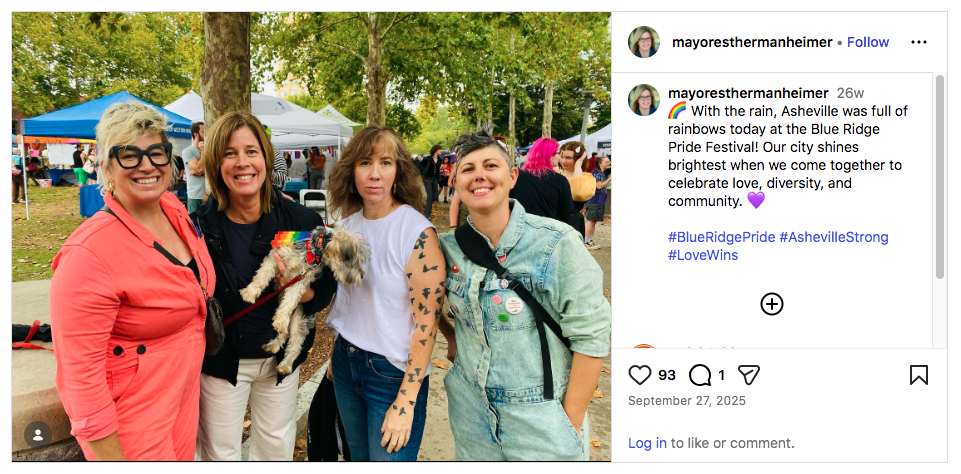
"I proudly advocated for and helped Asheville pass a comprehensive nondiscrimination ordinance."
Get There AVL QUESTIONNAIRE
*Get There Asheville is a city council questionnaire presented in partnership by Asheville on Bikes, MountainTrue, and Strong Towns Asheville.
Introductions
What would you like people to know about how you listen, learn, and lead?
I begin by listening to my community, learning the peoples’ values, priorities, concerns and opinions because I am in service to our residents. I inform my decision making with data, especially regarding transportation and housing needs, because we need to be forward looking and improvement focused and generally can learn from successes in similar communities. As a leader, I work to build systems that integrate and work best with robust, meaningful engagement and participation. This is because Asheville has many thought leaders with lived experience, expertise and deep caring about our community whose elevated voices can help produce better outcomes for all.
How do you most often travel around Asheville in your daily life, and how does that shape your experience of the city?
I drive, walk and bike. For work, I often travel to surrounding counties necessitating the use of a car. And to run errands, I try to consolidate trips using my vehicle. I also walk and bike all over Asheville. Walking and biking is a means to get from one place to another, but also recreational and social. Seeing a city on foot or on a bike changes your perspective. It allows me to see the challenges, deficiencies and enhancements in infrastructure across the city. I can experience a lack of sidewalk, a root in a greenway, a missing ADA ramp at an intersection, or a deficient bus stop, and understand in a first-hand way, where further improvements are needed.
What does equitable transportation investment look like to you in Asheville, and what experiences have informed how you think about it?
We do not have enough options for all people, particularly people with disabilities, and people who would either like to walk, bike, or ride the bus more or for whom walking, biking or riding the bus are their only affordable options. As mayor I have been working to improve transportation options by expanding multimodal infrastructure. I personally worked hard to promote the 2024 general obligation bond package, which will allow the city to build on the 2016 bond program that I also worked hard to promote. The concrete result is that the city can leverage millions of dollars for multimodal transportation, specifically in the areas of sidewalk and greenway construction.
I support continued investment in the Close the GAP Plan, to ensure that all have access to safe, connected non-motorized travel throughout the city.
Transit is also a transportation mode that I am proud to have expanded during my tenure, but which still falls short of meeting all the needs of people for whom a bus is their only affordable option. I will continue to support the improvement of Asheville's public transportation system toward the ideal of efficient, frequent, reliable service.
My personal experience in advocating, voting for and funding multi-modal transportation projects has taught me to work with our tremendous community partners and advocates to make bold and brave decisions such as the Merrimon Avenue Road Diet which I unwaveringly supported.
Growth Patterns & Housing
These questions are informed by the Elevate 2050 Metropolitan Transportation Plan, Asheville Missing Middle & Displacement Risk Assessment and Living Asheville a Comprehensive Plan for the Future.
Federal transportation dollars to improve Asheville’s streets, sidewalks, and highways are spent according to plans developed by our local Metropolitan Planning Organization.
The recently approved Elevate 2050 plan lays out 3 potential growth scenarios for our area: Business as Usual, Consolidated Growth, and Dissipated Growth.
Of these three scenarios, which do you think would be the best growth pattern for the Asheville area?
Consolidated Growth. The consolidated growth pattern makes sense for Asheville as it is focused in more urbanized, walkable areas, especially places with existing infrastructure that supports shorter trips and encourages use of public transit, walking, biking and other modes of non-vehicle transportation. Asheville needs to concentrate new housing, jobs, and development in locations that already have a higher level of development, along dense urban corridors, rather than growing out. For this reason, I strongly supported a recent zoning change that increases the threshold for by–right multi family housing to be constructed on urban corridors. Consolidated growth leads to more efficient land use, increased walkability, and reduced overall vehicle miles traveled compared with a business-as-usual or a dispersed growth pattern. There are also many pro-social positive outcomes: walkable and more connected neighborhoods become more closely knit and resilient. From a city’s infrastructure investment standpoint, consolidated growth also maximizes the city’s resources to impact the highest number of individuals.
Do you accept the premise that housing growth is a strategy to prevent displacement? Share more about your views on housing growth and displacement?
Yes, I support housing growth partnered with the implementation of the anti-displacement strategies recommended by the Missing Middle Housing study. Growth in housing is needed to address the affordable housing crisis and provide much needed housing to the thousands of people identified through the Bowen Housing study. But, coupled with strong support for an increase in housing supply, there must be increased investment in our most vulnerable neighborhoods. I fought for the award of millions of dollars in CDBG-DR funds after Hurricane Helene, traveling to Congress multiple times, resulting in an award of $225 million dollars. 70% of these funds must be spent in low to moderate income neighborhoods. This is an unprecedented opportunity to scale up investment in vulnerable neighborhoods, ensuring residents can stay in their homes through programs such as home repair programs and economic recovery investments.
Research has shown that the cities that create more housing options for renters through building multi-family housing, do a better job at preventing and reducing homelessness.
Do you think allowing middle housing types like duplexes and quadplexes by right in all residential neighborhoods would be an effective strategy to create more affordable housing in Asheville? Share more about your position on missing middle housing as use by right.
It could be. The biggest reason some cities have high rates of homelessness and others don’t is not because of poverty, mental illness, drug use, or local politics, but because of housing costs and housing availability. Housing scarcity is directly correlated with the percentage of unhoused individuals in a community. Because missing middle housing is yet one more tool for growing housing availability and therefore affordability, I strongly support code changes that would make it as easy as possible to build missing middle housing. And, I say that knowing that some of the most challenging votes I have ever had to cast were for missing middle infill housing. These tend to be the most controversial votes, which is why I have worked hard to bring neighborhoods and developers together, before the vote, to hammer out the compromises needed to get this housing over the finish line.
Complete Streets
These questions are informed by Asheville's Complete Street Policy.
When you think about “complete streets” in Asheville, what does that idea mean to you in practice? Can you share an example of a place where you think we’re getting it right—or could do better?
Complete streets means building streets that can be used, safely, by everyone, not just those in a car. That means they’re planned and built to work for walkers, bikers, transit users, car drivers, people of all abilities, and for emergency services. This means building transportation corridors with sidewalks, crosswalks, bike lanes or bike paths, bus lanes and good transit stops, safe intersections and traffic calming, trees, lighting and spaces for resting and gathering. Where we got this right is the RADTP project in the RAD, incorporating protected bike lanes, traffic circle intersections, benches, transit stops, multiuse paths, etc. Where we could do better is the Merrimon Ave Road Diet, where the lane markings are inconsistent and confusing, there is no protected bike lane, and there are too many curb cuts.
Aside from budgetary constraints, what's one barrier you see to Asheville becoming a safer city for people who walk, bike, use micromobility and/or assistive mobility devices?
Challenges include information, communications, divisiveness, politics and misunderstanding. From my experience in the early days of RADTP, there was great apprehension by some landowners in the RAD who thought greenways and multiuse paths would negatively affect their property. Change is hard but I am a fierce advocate for the continued retrofit of Asheville to multimodal transportation infrastructure because I believe, ultimately, it will benefit all Ashevillians.
Transit
This question is informed by the ongoing ART Comprehensive Operational Analysis.
Asheville is in the middle of a Comprehensive Operational Analysis of our bus system.
Residents were recently asked to consider two different network concepts: a coverage concept and a ridership concept. Which concept do you prefer for Asheville? Share more about your position regarding ridership or coverage.
The solution begins with a blended model between ridership and coverage. I defer to the transit users and experts as to which model makes the most sense for Asheville. While I have consistently supported public transportation and the funding needed to support it, while always looking for partnership opportunities to reduce cost, I am concerned about the capacity of the city to provide public transportation that people find useful in their everyday lives. With bus driver shortages and bus fleet challenges, ridership may be the direction the city must move toward, however, this decision will be made with the community.
Greenways & Trails
These questions are informed by Asheville's Close the Gap Plan, Recreate Asheville & The Hellbender Regional Plan.
What informs your vision for Asheville’s trails and greenways, and how would you move that vision forward?
I continue to be a strong supporter of building out the trails and greenways envisioned by the community and captured in the many planning documents. This vision emphasizes practical, safe infrastructure that moves people from home to work, school, shopping, recreation, etc. in a safe way using whatever mode of transportation individuals most readily have available to them. I have had the experience of living in a city where greenways connected me to work, school and shopping and I lived without a car (Boulder). I have lived in a city where transit is so robust and accessible no other means of transportation is needed (Jerusalem). I have worked with multimodal advocates to prioritize projects in Asheville by experiencing first-hand the successes of other communities (Minneapolis). I also strongly believe that a city’s role is to build recreational amenities for people to enjoy not only for mental and physical health but to experience joy with one another, and this includes trails for hiking and biking.
In your view, can investments in greenways and trails support affordability in Asheville—and where should we be thoughtful or cautious?
A comprehensive, usable and safe network of greenways, trails, bikelanes, and other multimodal transportation options creates greater affordability because it creates greater accessibility. However, it is important to recognize the linkage between these enhancements and potential gentrification. Done right, by simultaneously adding affordable housing, job opportunities, and other elements needed to level participation, greenways and trails can support affordability.
Reconstruction
These questions are informed by Asheville acceptance of Community Development Block Grant - Disaster Recovery and the ongoing French Broad & Azalea Parks Recovery Project.
The City has been allocated $225 million in CDBG-DR (Community Development Block Grant - Disaster Recovery) funds from HUD to aid our recovery from Hurricane Helene. HUD approved the city’s initial plan to spend $125 million on infrastructure, $52 million on Economic Revitalization and $31 million on housing.
Within the $31 million to be spent on housing, $28 million is dedicated to building affordable housing while the remaining $3 million is for single family home repair.
Recently, the city has proposed shifting over half of the funds originally planned for affordable housing construction over to single family home repair. Would you support that proposed change? Share more about your position regarding affordable multi-family construction - v - single family home repair.
I answer this question with both/and. Asheville’s housing affordability crisis must be addressed in all possible ways including bolstering the construction of affordable multi-family housing and funding single family home repair. Single family home repair for income qualified homeowners helps ensure that residents are able to stay and age in place in their homes, which preserves existing affordable housing stock. This question is specifically referencing the CDBG-DR funds designated for affordable housing, and under federal and state requirements, and due to the originally underestimated number of damaged homes from Hurricane Helene, the city was later required to shift monies designated for mutli-family housing to single-family home repair. Historically and on a continuing basis, however, the city has and will continue to fund both affordable multi-family apartment construction as well as single-family home repair, as both are needed to address housing needs.
Director D. Tyrell McGrit recently shared an update with City Council on the Riverfront Parks Recovery outreach and findings at the Jan. 13, 2026 City Council Work Session. What stands out to you about the work so far, and why?
I am committed to building back better, the parks along the Swannanoa (Azalea) and French Broad Rivers. Since Hurricane Helene I have been working tirelessly to secure the funds needed to rebuild these parks, utilizing federal public assistance funds, hazard mitigation, and CDBG-DR. But this is a community lead process and the city has built a robust program to harness the peoples’ vision for how these parks can be so much more than what they were before the storm, while being built to better withstand future disasters that we know are inevitable. I have learned that in addition to this being a complex federal and state funding landscape and an expensive endeavor, the people are eager to see this work happen fast and well. The first major community event brought more than a couple hundred people out to provide feedback and provide guidance for their vision of these parks. And the city is also working to meet people where they are so no one person or group can drown out the quieter voices in our city. We need to realize a vision for all of the people and not just a handful of louder voices.
Sunrise Movement WNC Questionnaire
*The following answers are in response to the Sunrise Movement WNC Questionnaire. Sunrise is a movement of young people fighting to stop the climate crisis and win a Green New Deal.
As our community works to recover from climate disaster, what are specific ways we can build climate change mitigation into Helene recovery efforts?
I’ve been advocating for and advancing climate change mitigation throughout my years of service, pre-Helene, and leading on ensuring mitigation is woven into our recovery efforts. It is anticipated that Asheville will receive approximately one billion dollars in federal funding related to Helene recovery and much of this funding is required to be spent on mitigation projects. This includes investment in the City’s water infrastructure, funding a water filtration system for Northfork costing more than 100 million. This includes rebuilding the Swannanoa River parks and the French Broad River parks, utilizing hazard mitigation funds that incorporate mitigation and build resiliency. This means creating resilience centers in partnership with the community to build on the strength of our neighborhood and communities and support and formalize the grassroots response that neighbors provided for one another in a time of crisis, to better prepare us for future climate disasters, which we know will happen. To make all of this a reality will require continuous advocacy in Washington to force the Department of Homeland Security to release the funding that has already been allocated by the Congress specifically for the recovery of WNC. This is an ongoing battle and one that I am laser focused on, working with our Congressional delegation and our Governor to hammer home. My continued work as Co-Chair of the Governor’s WNC Recovery Committee gives me a unique position to advocate for our community’s needs.
Would you support a system to evaluate climate change mitigation in recovery projects and overall development moving forward?
Yes, so long as it does not create a bigger bureaucratic burden and expense for Asheville residents, delaying effective action and wasting resources.
The City of Asheville and Buncombe County have set the goal to reach 100% renewable energy for government operations by 2030 and for community-wide use by 2042. We are not on track to meet these goals. What specific policies, programs, or spending would you champion to make real progress and overcome existing regulatory barriers and funding constraints?
This is disappointing given that we have invested and elevated in the city’s sustainability office since 2008, and adopted cutting-edge policies intended to make us nationwide leaders on sustainability (including renewable energy use). I’m not one to micromanage staff, and that is not the role of the Mayor or City Council, but what I am doing is leveraging my leadership with Climate Mayors and United States Conference of Mayors to bring learning to Asheville that will get us back on track with real progress and overcome existing regulatory barriers and funding constraints.
What are your budget priorities?
State law requires a balanced budget; we can’t adopt a budget that includes shortfalls. My priority is to combine practicality with vision in service to our residents.
Which departments or programs would you seek to fund more, and which do you think could be subject to cuts?
I don’t seek to cut anything. As a body, City Council will revisit our priorities (people, infrastructure and environment, housing, economy) as we enter the budgeting process. I continue to be a vocal advocate for our priorities.
If your jurisdiction comes into more revenue due to the recent property tax reassessments or other means, what would you do with that additional funding?
All current members of council received our initial budget information earlier this month and we are assured that is not the situation. It would be misleading to our residents to theorize in response to that question—people are living and seeing the practical impacts of rising healthcare costs, inflation, and the costs and timeline for recovery from Helene.
Transportation is one of the largest modifiable contributors to greenhouse gas pollution. Would you fight for more funding for public transit to cut emissions and alleviate traffic congestion?
After decades of implementing various marketing strategies (the app, the new wraps, hybrid and electric buses) and route changes/improvements, the vast majority of our bus riders continue to be people who rely on it as an essential service (out of need). This indicates that the majority of city residents who are potential riders actively choose other forms of transportation that are available to them, and it is likely that they are choosing transportation that contributes to emissions and/or congestion. That is a choice they are making. I am willing to put it to the voters to ask them if they want to invest in a sales tax for public transit (which North Carolina allows as a county-wide referendum), which could be a wonderful thing to improve services for our necessity riders, and which could reduce emissions and congestion if more residents would choose to ride the bus.
What ideas do you have for alternative funding sources?
I am willing to ask voters to vote in a referendum for a sales tax for public transit.
The Sunrise Movement is committed to a Green New Deal that eliminates the greenhouse gas pollution causing climate chaos and builds an economy that lifts up working people. What policies would you implement to move us closer to this goal?
I remain 100% supportive of a Green New Deal and the four pillars, which are reflected in our city’s priorities, policies, and sustainability plans. Follow-through is what’s needed.
In 2024, the town of Carrboro sued Duke Energy for its role in causing climate change and investing in decades of deception to discount the role of fossil fuels in causing climate change. Would you support a similar lawsuit following the worst climate disaster in NC history?
I’d seek qualified legal counsel on potential lawsuits that would prioritize benefits to our community; with the opioid settlement, for instance, Asheville received funds from the national class-action lawsuits and settlements negotiated by the North Carolina Attorney General's office. Care is necessary because, sometimes, lawsuits of that nature can eat up hundreds of thousands of dollars of tax-payer money with no guarantee of payback.
About 40% of solid waste produced locally is either divertable or compostable organics, yet neither Asheville nor Buncombe County offer a commercial composting service. If (re)elected, what steps would you take to provide municipal composting services to local businesses to reduce landfill usage and methane emissions?
Our city has a food waste reduction program and it includes a pilot project we are running to test the public’s interest in composting, which I support. Like most city services, we need to offer what residents need and want and find a balance between what we may wish they would do and what they choose to do. Residents have used this project to divert one million pounds of food waste from landfills, and I support analysis of the data and further public engagement to find out whether municipal composting services is a priority for our residents.
If you are elected, do you pledge to use your office to raise and maintain the starting salaries of all public employees to a living wage?
Yes, I will continue to be a staunch advocate for living wages, continue to support living wage and robust benefits for our employees, and continue to support our community’s voluntary living wage certification programs.
Do you pledge to advance and support a resolution establishing a living wage ordinance for all public employees in local government?
Yes.
For reference, living wage is a defined salary level at which a full-time employee spends no more than 30% of their gross annual income on their housing costs. Housing prices are determined by averaging the Department of Housing and Urban Development's four most recently published years' one-bedroom Fair Market Rents for the relevant metro area.
Yes.
Many young people are scared for our future both environmentally and economically and don’t think our political system is working for us. What message do you have for young people and what would you do to ensure we all have access to a livable future?
I reflect on this all the time with my three sons, with whom I am close and who are living this reality, who have grown up during these times of environmental, economic, and political turmoil and, dare I say, fatalism. I spend most of the time listening. My message is that this is part of my lived experience, being a human being, a spiritual person, and a parent through these times, and my concern for our future will remain front and center and my leadership and public service will continue to reflect my responsibility to effectively care for and heal our planet, our people, and our politics.
personal
What experience or achievement are you most proud of that prepares you to be mayor of Asheville?
I am proud of being mayor of Asheville since 2013, serving through times with lean budget and times with robust budgets, fighting and winning back our water system, showing up in classrooms to support students, advocating for successful voter-approved bond referendums, advocating for compassionate public safety practices, showing up in the streets to support Asheville’s values, leading through COVID and Helene, and that has given me some on the job experience to prepare me to be Mayor of Asheville.
What is one promise you will make to Asheville voters if elected?
To be brave and relentless and keep the focus on moving forward.
How can residents stay engaged with you after the election?
I value and encourage engagement. I have an open door policy, residents can email me (mayormanheimer@gmail.com) or call me 828-231-8016 (my cell) and ask to meet or share their suggestions, concerns, and questions. Of course residents can also participate in council meetings and city community events, campaign events, or participate in an input forum or session or even answer a city survey.